
Before applying, applicants are encouraged to review the available resources to ensure they understand the requirements and expectations of the application process. These resources include guidance on certification standards, required documentation, and helpful templates to support program development. Reviewing these materials in advance can help streamline your application and reduce the need for follow-up.
Overview
University of Saskatchewan CME is a Committee on Accreditation of Continuing Medical Education (CACME) accredited provider and can accredit activities for both The Royal College of Physicians and Surgeons of Canada (RCPSC), and College of Family Physicians of Canada (CFPC). Programs that are accredited distinguish themselves from those that are not in that they represent high quality learning experiences for your learners that are demanding a level of educational excellence associated with the University of Saskatchewan.
The accreditation process by USask involves a peer review with the planning committee to certify that the educational curriculum is up to a strict scientific standard, that the National Standards for CPD Accreditation have been followed and elements of commercial bias are absent from all aspects of planning and execution. Elements such as a proper needs assessment, event and session objectives, appropriate formats for assessment and evaluation and conflict of interest declarations are all part of producing an event that is free of bias and worthy of accreditation.
Programs that are accredited will be permitted to use the University’s name and logo on marketing materials, which ensures learners are made aware of the program’s high quality and rigorous planning processes.
Why work with CME?
Program Committees and Chairs who work with CME at USask can expect:
- Guidance through the accreditation process and help in the implementation of your activity.
- Access to our experience, as to best practices and strategies for program design, program production and delivery on issues that are relevant and important to your learners.
- A higher quality of educational event with targeted learning objectives that are outcome based and programming that is based around health issues that are relevant and timely.
- The benefit of our marketing processes which advertise the event through the University of Saskatchewan at its distributed sites across Saskatchewan.
Understanding the NEW Mainpro+ Certification Standards
Mainpro+ Certification standards have changed effective December 16, 2024. We are currently updating our website to reflect these new standards. For more information on these changes please visit the CFPC website HERE.
Eligibility
- Only physician organizations are eligible to apply for credits
- Please refer to the resources tab for learning activities that qualify for accreditation
Application Process
Please submit your application as early as possible to allow sufficient time for processing. The standard review period ranges from 4 to 6 weeks, depending on the complexity of the application and the volume of submissions at the time. Early submission helps prevent delays and ensures enough time for review, any needed revisions, and final approval.
Please be aware that any posters or other materials used to market your event prior to accreditation approval should NOT contain any accreditation statements or any mention that accreditation is pending. Once your program has been approved you will be supplied with the appropriate statements that can be added to your posters, agenda and other materials used for marketing purposes.
Below is a detailed, step-by-step breakdown of the review process to help you understand what to expect.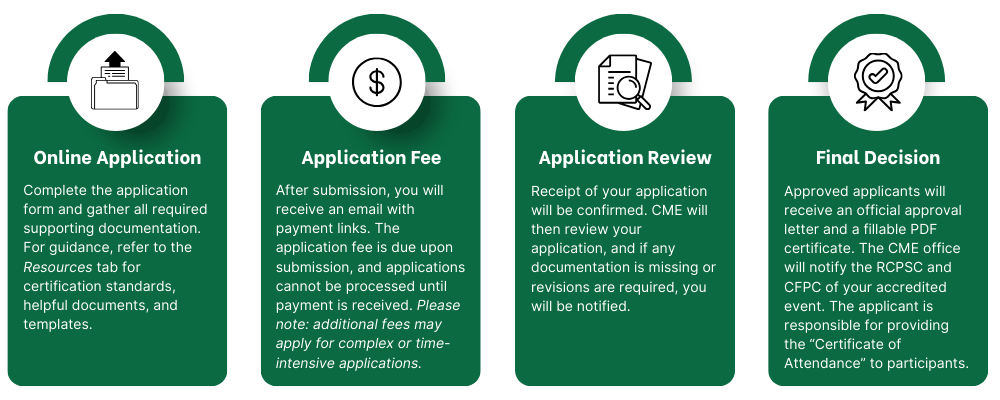
Credit Types
On behalf of Canada’s two national medical colleges, CME is able to administer the following accredited options:
| MOC Section 1 Group Learning | MOC Section 3 SAP and SIM | Mainpro+ Certified Credits | |
|---|---|---|---|
| CPD developed by Division of CME |  |
|
|
| CPD developed by College of Medicine Faculty | |
|
|
| CPD externally developed | |
|
Royal College of Physicians and Surgeons of Canada (Specialists):
Maximum of 50 credits for unaccredited activities in Section 1 per five-year cycle.
Knowledge, skills and abilities acquired through group or team learning activities, including collaborative interprofessional and patient partner activities.
Activities must be interactive through opportunities for discussion and can be in-person or virtual.
- Conferences: Accredited: 1 credit per hour | Unaccredited: 0.5 credits per hour
- Journal clubs: Accredited: 1 credit per hour | Unaccredited: 0.5 credits per hour
- Rounds: Accredited: 1 credit per hour | Unaccredited: 0.5 credits per hour
- Courses: Accredited: 1 credit per hour | Unaccredited: 0.5 credits per hour
- Seminars/Workshops: Accredited: 1 credit per hour | Unaccredited: 0.5 credits per hour
- Webinars (live): Accredited: 1 credit per hour | Unaccredited: 0.5 credits per hour
- Small-group sessions: Accredited: 1 credit per hour | Unaccredited: 0.5 credits per hour
- Resuscitation courses: Accredited: 1 credit per hour | Unaccredited: 0.5 credits per hour
- Social media for knowledge translation: Unaccredited: 0.5 credits per hour to a max. of 5 credits per year
- Case-based discussions: Unaccredited: 0.5 credits per hour
- Patient-partnered learning: Accredited: 1 credit per hour | Unaccredited: 0.5 credits per hour
For more information about MOC Section 1 Group Learning, go to The MOC framework
Knowledge, skills and abilities acquired through independent, self-directed learning activities.
- Educational content review (reading, listening, watching): Unaccredited: 0.5 credits per hour to a max. of 30 credits per year
- Courses (asynchronous): Unaccredited: 0.5 credits per hour
- Individual task training: Unaccredited: 0.5 credits per hour
- Activity preparation (previously Personal Learning Project of PLP): Unaccredited: 2 credits per hour
- Postgraduate studies (Fellowships, Masters, PhD): Unaccredited: 50 credits per year, per initiative
- Traineeships: Unaccredited: 20 credits per year
For more information about MOC Section 2 Individual Learning, go to The MOC framework
Feedback received, feedback delivered (previously peer-reviewed), improvement initiatives.
Feedback received
Feedback received on your knowledge, skills or performance that enables you to identify opportunities for future learning or Quality Improvement (QI) activities or both.
- Accredited self-assessment programs (SAPs): Accredited: 3 credits per hour
- Receiving, reviewing and reflecting on feedback: Unaccredited: 3 credits per hour
- Simulation activities: Accredited: 3 credits per hour | Unaccredited: 1.5 credits per hour
- Coaching or mentoring (as a recipient): Unaccredited: 3 credits per year
Feedback delivered (previously peer-reviewed)
Feedback delivered to individuals, groups, teams or systems.
- Review of feedback delivered: Unaccredited: 3 credits per hour to a max. of 15 credits per year
- Coaching or mentoring (as a provider): Unaccredited: 3 credits per hour to a max. of 15 credits per year
Improvement initiatives
Activities carried out to improve patient care; physician well-being; professional practice; medical education; health systems; equity, diversity, and inclusion; planetary health; and other areas.
Quality improvement: ‡ Quality improvement (QI) is an action-oriented, problem-solving framework that can help you enhance your practice and your personal or professional development. ‡ Includes MRA QI activities.
- Individual improvement: Self-directed improvement activities: Unaccredited: 25 credits per QI initiative, per year
- Group improvement activities - Group member of a QI activity: Unaccredited: 15 credits per QI initiative, per year
- Group improvement activities - Leading role for a group QI activity: Unaccredited: 35 credits per QI initiative, per year
System improvement
Activities carried out to improve patient care; physician well-being; professional practice; medical education; health systems; equity, diversity, and inclusion; planetary health; and other areas.
- Committee participation: Unaccredited: 15 credits per year (chair), per committee OR 10 credits per year (member), per committee
- Curriculum development: Unaccredited: 15 credits per year, per initiative
- Examination development: Unaccredited: 15 credits per year, per initiative
- Clinical practice guideline development: Unaccredited: 15 credits per year, per initiative
- Adverse event investigation, reporting and analysis: Unaccredited: 5 credits per initiative
For more information about MOC Section 3 Feedback & Improvement, go to The MOC framework
College of Family Physicians of Canada (Family Physicians):
Certified Credits: Activities (seminars, conferences, clinical rounds programs, webinars, asynchronous online activities, etc.), that have been formally reviewed and approved as per the standards for certified CPD set by the CFPC.
- Examples of Certified Activities:
• Conferences/workshops/small group learning/rounds
• Journal clubs
• Asynchronous online independent and/or group learning activities
• Blended learning activities
Certified Assessment Credits: Certified activities (practice audits, practice assessments, chart audits, simulation activities, etc.) in which analysis of data, including providing or receiving feedback, stimulates self-reflection and leads to practice/performance improvement. These may be self-directed or conducted with others.
- Examples of Certified Assessment Activities:
• Self-assessment programs
• Simulation programs
• Practice review or practice audit activities
• Quality improvement programs
• Formal mentorship programs
Combined Activities: Are educational offerings that integrates elements of both a Certified Activity and a Certified Assessment Activity. It involves the structured delivery of educational content, such as seminars, conferences, or webinars, alongside the incorporation of a data-driven assessment component, such as practice audits, simulation activities, or chart reviews. Additionally, any optional activity enhancements must be explicitly linked to the core category of the Combined Activity. These activities are formally reviewed and approved according to the standards for certified CPD set by the CFPC, and they aim to facilitate self-reflection, foster feedback exchange, and drive practice or performance improvement.
Non-certified Credits: Activities that are not formally reviewed but comply with the College’s definition of CPD. They must be non-promotional and provide valuable professional learning opportunities that can be used for non-certified credits.
- Examples of Non-certified Activities:
• Journal reading
• Non-sponsored, non-reviewed conferences/workshops
• Teaching
• Guidelines review
Document Submission Checklist
The checklist below outlines the documents you should gather in advance of applying. While you may begin the application without having all required documents ready and save your progress to return later, all listed documents must be uploaded before you can submit your application. These documents represent the core requirements for all credit types; however, additional documents specific to certain credit types may also be required and will be requested directly within the application form. Submitting a complete application with all required documentation helps support an efficient review process; missing documents may result in delays while additional information is requested.
-
Budget
A detailed financial plan showing all income sources and projected expenses. It should also outline how any surplus or deficit will be managed. Click here to view a sample. - Conflict of Interest forms
Signed declarations from planning committee members, confirming any relevant relationships or interests that could influence program content. Click here to view and download the standard COI form. Additionally, there is now an Alternative COI form for Indigenous Elders, Patient Partners & Individuals with Lived Experience. - Three-step conflict-of-interest slide template
A standardized slide used during presentations or in programs to disclose any potential conflicts of interest by speakers or the planning committee, ensuring transparency. Click here to view and download the template. - Speaker communication
Documentation of correspondence with speakers, including invitations, confirmations, and instructions about accreditation requirements. - Program agenda and/or program invitation or brochure
A clear schedule or promotional material outlining session topics, speakers, and timing for the accredited activity. - Description of the assessment tool
Explanation of the method used to assess participant learning (e.g., quizzes, case studies, reflective exercises). This will only be required for certain applications. - Evaluations
Post-activity feedback forms designed to measure participant satisfaction and learning outcomes. Click here to see the Mainpro+ evaluation requirements and the MOC evaluation requirements. - Previous evaluation results
Data from past sessions or similar programs, demonstrating how feedback has informed improvements. - Tools used to facilitate needs assessment
Evidence of surveys, interviews, or data analysis conducted to identify learner gaps and inform program design. - Sponsorship Agreement & Branding
A formal agreement outlining the terms of financial or in-kind support to ensure compliance with ethical standards. This is only required if your program has sponsors. If applicable, include examples of how sponsors will be recognized (e.g., logos on materials) in accordance with accreditation guidelines for impartiality.
Resources
Application Fees
There is a non-refundable accreditation application fee per application form payable to CME for review of each application. Please use the links below to pay for the appropriate application. Fees will not be refunded if the application is not approved or if the application is withdrawn.
Mainpro+ Certified/Certified Assessment Accreditation Fee: $1000 + tax
MOC Section 1 Accreditation Fee: $1000 + tax
MOC Section 3 SAP Accreditation Fee: $1500 + tax
MOC Section 3 SIM Accreditation Fee: $1500 + tax
Apply
Submit your application after your program is fully developed and before any advertising or marketing begins. Please note that old PDF forms will no longer be accepted. Please ensure you complete the online application form by clicking on the Apply Now button below.
The application fee is payable either before you apply or once you have completed and submitted the online application form. You will receive an email with the payment links directly after submitting the online form, or you can use the payment links under the Application Fees tab on this page. Please note that we cannot start processing your application until we have received payment.
To get started, click Apply Now to access the online application form. You can save your progress at any time. Program materials and signed documents can be uploaded directly within the form.
Planning Information
Applying for accreditation is only one part of the process. Programs must be intentionally developed and delivered in accordance with established accreditation requirements.
Accredited CPD activities are expected to consistently meet ethical, educational, and administrative expectations across the full lifecycle of the program, from concept to delivery. These expectations are integrated into each of the program planning stages described below:
Only physician organizations can request accreditation for CPD activities.
Key Requirements:
-
The organization must design and oversee the CPD activity, including all financial decisions, in line with CPD Ethical Standards.
-
Must be a not-for-profit group of healthcare professionals with a formal governance structure.
-
Must have been in existence for at least one year.
Membership Must:
-
Include physicians (not just the board).
-
Have defined eligibility criteria and member expectations (e.g., dues).
-
Grant members voting rights on organizational initiatives and strategy.
Eligible Organizations Include:
-
Faculties of medicine
-
Hospital departments or divisions
-
Medical societies, associations, and academies
-
Physician research organizations and clinics
-
Health authority hospital departments or medical advisory committees (HAMAC)
-
Canadian provincial medical regulatory authorities (MRAs)
First-Time Applicants:
-
May need to provide supporting documents (e.g., Terms of Reference, constitution, governance policies).
-
This could extend the review process beyond the standard 4–6 weeks.
Not Eligible:
-
Commercial healthcare/pharmaceutical companies (HPIs)
-
Health authority administrative offices
-
Disease-specific patient advocacy groups
-
Government departments or agencies
-
Small groups of physicians collaborating solely on educational content
-
CPD Activity Oversight
-
Every CPD program must be overseen by a scientific planning committee (SPC) accountable to a fiscally responsible physician organization.
-
The SPC ensures the integrity of the learning environment, the quality of content, and adherence to CPD Ethical Standards.
-
CPD activities must remain free from promotion or sales of products/services for any professional or financial gain, including those of SPC members.
-
-
SPC Composition & Roles
-
Must include at least two physicians.
-
Should reflect the target audience.
-
Members must understand accreditation/certification responsibilities.
-
A chair and a defined decision-making process are required to manage responsibilities effectively.
-
-
Disclosure & Declarations
-
All SPC members must sign disclosures and submit role-specific declarations with the application.
-
-
SPC Responsibilities
-
Uphold CPD Ethical Standards throughout the activity.
-
Identify educational needs of the intended audience.
-
Develop learning objectives.
-
Select educational methods appropriate to the objectives.
-
Appoint SPC members, speakers, moderators, facilitators, and authors.
-
Develop and deliver content.
-
Evaluate learning outcomes.
-
Oversee logistics of the activity.
-
Review disclosures and address conflicts of interest.
-
Ensure commercial support and sponsorship comply with standards.
-
-
Conflict of Interest (COI) Overview
-
A COI arises when external interests interfere or appear to interfere with the primary goal of an accredited CPD activity.
-
Best practices require full transparency of all financial relationships for individuals involved in CPD development through a disclosure process.
-
-
Disclosure Review Process
-
SPC members: Collect and submit disclosures with your accreditation application.
-
Content contributors (speakers, authors, instructional designers, facilitators, moderators, etc.): Collect disclosures for SPC review.
-
Learner communication: Disclose all relevant financial relationships after SPC review confirms no COIs; ensure transparency through written (slides) and verbal disclosures.
-
-
COI Management Responsibilities
-
SPC members must review disclosures from each other and all content contributors.
-
Eliminate unresolvable financial relationships and mitigate relevant financial relationships.
-
-
Eligibility for Accreditation
-
CPD activities must have physicians as the primary target audience (specialists, family physicians, or both).
-
-
Importance of Defining the Target Audience
-
Helps guide program design and content.
-
Determines the most appropriate type of CPD credit.
-
-
Verification of Physicians’ Credentials
-
Individual physicians can be checked through:
-
Provincial regulatory college directory
-
National medical college directories
-
-
Ensures correct identification of certified areas of practice in Saskatchewan.
-
-
Purpose of Needs Assessment
-
Collects information to identify the learning needs of the target audience.
-
Learning needs form the basis for learning objectives, content, and educational format.
-
Helps demonstrate a valid professional practice gap by describing:
-
Target audience
-
Work environment or activities
-
Current vs. desired knowledge or skill levels
-
Preferred learning styles
-
-
-
Best Practices
-
Use multiple methods to identify needs linked to improved patient care.
-
-
Key Questions for SPC
-
How common is the need among the target audience?
-
How many different assessment sources support this need?
-
How much does the unmet need hinder health care delivery?
-
How directly does it relate to physician performance?
-
How likely is a CPD activity to improve practice behavior?
-
Are sufficient resources available to address the topic effectively?
-
How receptive will the audience be to a session on this topic?
-
-
Submission Requirement
-
Since the National Standard (Jan 2018), needs assessment tools (e.g., past evaluations, focus group questionnaires) must be included with the accreditation application.
-
-
Accreditation Requirement
-
Programs must link at least one learning objective to one of the seven physician roles to be eligible for accreditation.
-
-
CanMEDS & CanMEDS-FM Frameworks
-
Developed by Canadian medical colleges.
-
Outline the abilities physicians and surgeons need to meet patient and population health-care needs.
-
Abilities are organized under seven thematic physician roles.
-
-
Financial Accountability
-
The physician organization holds full responsibility for the CPD activity’s finances.
-
All income and expenses must be processed through the organization.
-
-
Financial Principles
-
CPD activities should aim to be self-sustaining, not profit-generating.
-
Surplus funds from recurring activities:
-
Earmarked for future planning, development, or delivery of similar activities.
-
-
Surplus funds from single/non-recurring events:
-
Returned to the physician organization, not individuals.
-
Used to support continuing education within the organization.
-
-
-
Budget Creation & Submission
-
Include all funding/revenue sources and all expenses, even if internally funded.
-
Specify how any surplus or deficit will be managed.
-
Submit a comprehensive budget with projected revenues and general expenses as part of the application package.
-
-
Commercial Sponsorship Guidelines
-
Follow the CPD Ethical Standards for Accredited CPD Activities when seeking sponsorship.
-
Participant registration fees are required if commercial sponsorship is used.
-
-
Approved Sponsorship
-
Only CPD-approved sponsorship opportunities may be offered.
-
All sponsorship arrangements must be documented in a written agreement signed by:
-
The CPD provider organization
-
The for-profit sponsor
-
-
The agreement should reflect the terms, conditions, and purpose outlined in the sponsorship request/prospectus.
-
-
Credit Type and Learning Format
-
The type of CPD credit is determined by the learning format and what the learner will experience.
-
-
Updates to CFPC Credit Framework
-
Effective December 16, 2024, the Mainpro+ credit framework has been updated.
-
Mainpro+ Certified now encompasses all eligible learning formats, including:
-
Group learning
-
Online modules
-
Knowledge assessments
-
Simulations
-
-
-
Additional Notes
-
MOC credits remain unchanged.
-
-
Learning Objectives Requirements
-
Develop objectives that address identified learning needs for:
-
The overall CPD event
-
Individual sessions
-
-
Objectives must be accessible to participants.
-
-
Characteristics of Learner-Centered Objectives
-
Specific and concise
-
Focus on short-term, concrete outcomes
-
Describe what learners will do differently after the activity (changes in learner behavior)
-
-
CPD Activity Design
-
Base the activity on professional practice gaps identified in the needs assessment.
-
-
Program Development
-
Create a detailed agenda including:
-
Topics and speakers
-
Start and end times
-
Q&A/discussion periods
-
Breaks
-
-
Include learner-centered objectives in the program.
-
Calculate credit hours by totaling educational hours minus breaks.
-
-
Accountability & Standards
-
Clearly identify the responsible physician organization on all materials.
-
Communicate accreditation standards to all content developers and speakers.
-
-
Informing Content Contributors of Accreditation Standards
-
The SPC must communicate requirements to all content contributors (e.g., presenters, authors, instructional designers, facilitators, moderators).
-
-
Content Development Requirements
-
Base content and learning objectives on the identified needs of the target audience (SPC should share these needs).
-
Create learner-centered objectives.
-
Present balanced views on therapeutic options, reflecting current scientific literature.
-
Use generic names (or both generic and trade names) and avoid exclusivity/branding.
-
Declare off-label use when recommending medications without regulatory approval.
-
Minimize bias - commercial or otherwise.
-
Disclose all financial relationships with commercial and not-for-profit organizations.
-
Presenters must disclose both verbally and on slides.
-
-
Include references to evidence used in content development.
-
Adhere to time limits, including interactive elements like Q&A.
-
Ensure SPC review of all content/materials before learner access.
-
Comply with professional standards and legal requirements, including:
-
Privacy
-
Confidentiality
-
Copyright
-
-
Your CPD program is now ready to be submitted for credit approval. Before applying, review the Documentation Submission Checklist to ensure you have gathered all required documentation. Once you are confident everything is complete, proceed to the Apply tab to submit your application.
Once your program is approved, you will receive an email confirming accreditation, which includes your official accreditation/certification statement for use on participant certificates and promotional materials. All participants must be able to register and receive a receipt or record of registration. Attendance records are maintained by CME for six years. A certificate of participation or written confirmation, signed by the SPC chair, must be issued to all participants of accredited or certified activities. Physicians claim credits by logging into their member portal with the Royal College (for MOC credits) or the CFPC (for Mainpro+ credits). Non-physicians may also use these certificates as proof of participation.
Each certificate must include:
-
Participant name
-
Activity title as submitted in the application
-
Name/logo of the physician organization responsible for the activity (and co-developer, if applicable)
-
Date(s) of the activity
-
Location of the activity (city, province, or virtual base)
-
Official accreditation/certification statement, including number of CPD credits
-
Cert+ session ID (Mainpro+, MOC SAP/SIM only)
Purpose of Evaluation
-
Evaluation is mandatory for all accredited/certified CPD programs.
-
Provides feedback to program planners and faculty to improve future activities.
-
Learners must have the opportunity to evaluate the program confidentially and meaningfully, but evaluation should not be required to receive CPD credit.
FAQ
Mainpro+ Credits: Family physicians can claim one Mainpro+ Non-certified Activity credit for each hour spent on teaching activities. This may include the time spent developing and delivering a presentation. Linking Learning Exercises (Linking Learning to Teaching) can be completed for lecturing and are eligible for five Mainpro+ certified credits.
https://www.cfpc.ca/en/education-professional-development/cpd-at-cfpc/linking-learning-exercises
MOC Credits: Royal College members may submit MOC Section 2 credits as Personal Learning Projects (PLPs) for preparing formal teaching activities and presentations. MOC Section 3 credits may be claimed for time spent reviewing and reflecting on annual teaching evaluations from CME presentations.
Yes!
College of Family Physicians of Canada members may claim one Mainpro+ Non-certified Activity credit for each hour spent on committee participation, curriculum development and educational planning. Log in to your Mainpro+ account to submit credits.
Royal College members are eligible for unaccredited MOC Section 3 credits for committee participation. The committee focus may include such topics as to improve patient care, physician well-being, professional practice, medical education, health systems, equity, diversity, and inclusion, or planetary health. The committee must have a formal structure, appointment process, defined terms of reference and a minimum of two meetings per year. Committee chairs may claim up to 15 credits per committee. Committee members may claim up to 10 credits per committee. Log in to your My MOC to submit credits.
CFPC
The CFPC has three CPD activity categories: Certified Activities, Certified Assessment Activities, and Non-Certified Activities (see examples in the table below).
- Certified credits are awarded for activities that have been reviewed and approved by the CFPC, a CFPC Chapter, or a Canadian university’s CPD office accredited by the Committee on Accreditation of Continuing Medical Education (CACME) and judged to have met the Mainpro+ standards for certified CPD
- Non-certified credits may be claimed for activities that have not been formally reviewed by the CFPC but that comply with the CFPC’s definition of CPD are non-promotional in nature, and provide valuable professional learning opportunities.
Certified Activities |
Certified Assessment Activities |
Non-certified Activities |
| Asynchronous online learning activities (independent and/or group) | Self-assessment programs | Journal reading |
| Conferences, workshops, group learning sessions | Simulation programs | Teaching |
| Rounds, Journal Clubs & Webinars | Quality improvement programs | Guidelines review |
| Blended learning activities | Formal mentorship programs | Non-sponsored, non-reviewed conferences/workshops |
Combined Activities
A Combined Activity is an educational offering that integrates elements of both a Certified Activity and a Certified Assessment Activity. It involves the structured delivery of educational content, such as seminars, conferences, or webinars, alongside the incorporation of a data-driven assessment component, such as practice audits, simulation activities, or chart reviews. Additionally, any optional activity enhancements must be explicitly linked to the core category of the Combined Activity. These activities are formally reviewed and approved according to the standards for certified CPD set by the CFPC, and they aim to facilitate self-reflection, foster feedback exchange, and drive practice or performance improvement.
Enhanced Activities (Optional)
Must be included with a Certified Activity of Certified Assessment Activity.
For more information, please visit the CFPC website.
RCPSC
The RCPSC has three types of learning modalities: MOC Section 1, MOC Section 2: Individual Learning & MOC Section 3: Feedback and Improvement (see examples in the table below).
Section 1 - Group Learning |
Section 2 - Individual Learning |
Section 3 - Feedback and Improvement |
| Conferences | Learning plans to address specific needs | Gathering data and feedback to help identify needs in knowledge, skills, competencies or performance. |
| Journal Clubs | New evidence to practice | |
| Rounds | QI projects |
For more information, please visit the RCPSC website.
Programs approved as Certified Activities will have a certification period of 12 months from the approval date.
Programs approved as Certified Assessment Activities will have a certification period of 36 months from the approval date.
Faculty development activities, whether Certified or Certified Assessment, will have a certification period of 36 months from the approval date.
With a blended learning program, if both Certified and Certified Assessment aspects are of equal value, the certification period reflects the activity type with the longer duration. If it equals 50 per cent or more, the certification period will be 36 months.
All migrated active programs will maintain their original expiration dates.
Please note that all programs offering two or three credits per hour will have expiration dates no later than December 31, 2025.
Enhanced activities are optional add-ons for both participants and providers. They are not required in an application. These activities serve as a resource that providers can use if they wish to offer additional learning opportunities. Participants also have the option to choose whether or not to engage in these enhanced learning activities.
Providers who wish to offer participants the opportunity to earn additional optional credits may incorporate the following elements into their program:
- A needs assessment activity for participants, incorporating data from their practice
- Practice tools and resources with follow-up to assess their impact on practice, enhancing relevance and reinforcing learning post-program
- An exercise that includes formal reflection on applying learning to practice over a practical period, aimed at assessing changes in practice
- An objective measurement of change for participants, which may include, but is not limited to:
- Knowledge test
- Commitment to change with follow-up
- Patient outcome measurement
Submitters requesting approval for enhanced activities must submit the proposed activities for review and explain how they align with the program's learning objectives. They must also provide an estimate of the additional time required to complete these activities to justify the allocation of optional credits.
No, not on their own. Applications requesting Certified Assessment Activity credits must include the review and reflection on practice data in relation to previously established standards, protocols, and norms. Knowledge-based assessments, such as multiple-choice questions, are not enough on their own to ensure interactivity and engagement. They should be combined with other activities as part of a broader reflection on practice.
This varies, based on provincial or national certification:
- Provincial Certification: at least one Practising class CFPC member from the province of program delivery
- National Certification: at least two Practising class CFPC members
Beginning December 16, 2024, CPD providers will be required to outline their approach to EDI in each application. Although applications will not be rejected solely for lacking EDI elements, we may request additional information to clarify the approach or encourage the integration of EDI principles in future development.
If a CPD provider has received either financial or in-kind support from a for-profit organization, the activity is classified as a for-profit funded activity.
If no funding or in-kind support is provided but the activity is being developed by a for-profit organization, it is still classified as for-profit.
If no funding or in-kind support is provided but the activity is being developed by a for-profit organization, it is still classified as for-profit.
Contact Us
Please reach out to the CME team at cme.accreditation@usask.ca if you need any assistance or have any questions.